


Sludge halls in the chemical and wastewater industries harbor an often underestimated danger: sewage sludge continuously outgasses methane (CH₄). Under unfavorable ventilation conditions, the CH₄ concentration can locally reach safety-critical levels. Since the lower explosive limit (LEL) of methane is as low as 4.4 vol.%, reliable, continuous methane monitoring is indispensable – as a core requirement of GefStoffV, BetrSichV, and the relevant technical rules TRGS 720 and TRBS 2152 Part 1/TRGS 721 (Hazardous explosive atmospheres). In this article, we demonstrate how Fresenius Umwelttechnik implements such safety-relevant CH₄ monitoring in a sludge hall – and why the choice of measurement principle determines whether you get reliability or a false alarm.
Initial Situation: Sewage Sludge Atmosphere as a Measurement Challenge
In the sludge hall of our application case, several unfavorable factors coincide: high humidity, dust, varying temperatures up to 50°C in the sample gas, and a complex gas matrix consisting of CH₄, H₂S, CO₂, and O₂. The area is designated as an Ex zone in accordance with ATEX Directive 2014/34/EU and the EN 60079 series of standards.
At first glance, the measurement task appears simple: detect methane in the range of 0–10 vol.% so that alarms can be reliably triggered below the LEL. In practice, however, selectivity and long-term stability determine whether an analyzer provides resilient values in continuous operation – or becomes a risk due to cross-sensitivity and sensor poisoning.
Why NDIR instead of Pellistor? Safety through Selectivity
Classic pellistor sensors (catalytic bead) are widely used in industrial gas warning systems. However, in a sludge hall atmosphere, they reach their physical limits:
- H₂S poisoning: Hydrogen sulfide leads to deactivation of the catalytic element and thus to systematically low measured values – a critical safety risk for LEL monitoring.
- Silicone and siloxane exposure: Sewage sludge emissions often contain siloxanes, which irreversibly damage the pellistor and drastically shorten its service life.
- Oxygen deficiency: Pellistors require O₂ for catalytic combustion. If the oxygen content drops below approximately 10–15 vol.%, the signal falls – even though methane is still present.
- Non-specificity: A pellistor detects any combustible gas – it cannot distinguish methane from other hydrocarbons, which can lead to false alarms.
Non-dispersive infrared spectroscopy (NDIR) structurally bypasses these weaknesses. Methane absorbs infrared radiation characteristically at approximately 3.3 µm – a wavelength range in which neither H₂S nor CO₂ exhibit dominant absorption bands. Using a dual-beam approach with a reference channel at a non-absorbing wavelength, the methane signal is corrected for drift and matrix influences. The result: a selective, poisoning-free CH₄ measurement that remains stable even in atmospheres containing H₂S and CO₂.
Our Solution: GA210 with Adapted LEL Measuring Range
For this application, we rely on the Gas Analyzer GA210 from Fresenius Umwelttechnik in the LEL version with NDIR dual-beam technology. Instead of a standard measuring range up to 100 vol.%, the analyzer is optimized for 0–10 vol.% CH₄ – precisely the safety-relevant range around the LEL of 4.4 vol.%. Due to the optimized measuring cell geometry and adapted characteristic curve evaluation, resolution and accuracy are fully available within the critical window.
| Parameter | Design |
| Measured component | CH₄ (Methane) |
| Measuring range | 0–10 vol.% |
| Measurement principle | NDIR dual-beam with reference detector |
| Resolution | 0.1 vol.% |
| Detection limit | 0.5 vol.% |
| Measurement uncertainty | ≤ 3% of the measured value |
| Response time (Tₐ₀, analyzer) | approx. 3 s |
| Measurement interval | Every second (continuous) |
| Pressure compensation | 0.7–1.1 bar abs. |
| Measuring cell | Temperature-stabilized at 45°C |
| Cross-sensitivity | None towards H₂S and CO₂ |
| Sample gas pump | Internal, approx. 4 l/min |
| Analog output | 4–20 mA (PLC integration) |
| Zero point adjustment | 1× daily, approx. 2 min, automatic with ambient air |
Response Time: Is an Extractive System Fast Enough for LEL Monitoring?
With extractive measurement systems – i.e., systems where the sample gas is transported to the analyzer via a sampling line – the question legitimately arises: Is the total response time sufficient for safety-relevant LEL monitoring? The answer is derived from three factors.
Factor 1: The Dynamics of Methane Increase in the Hall Volume
Sludge halls typically have a room volume of several hundred to several thousand cubic meters. Even in the event of a sudden outgassing incident, the CH₄ concentration in the hall volume increases relatively slowly – the dilution in the large room volume acts as a natural buffer. An increase from ambient level to the pre-alarm threshold of 0.88 vol.% (20% LEL) takes minutes in practice, not seconds. The decisive question is therefore not whether the analyzer reacts in 3 or 30 seconds – but whether the overall system reliably detects the increase in concentration before a critical level is reached.
Factor 2: Fast Gas Transport via High-Performance Pump
The internal sample gas pump of the GA210 delivers approx. 4 l/min – a comparatively high volume flow for an analyzer of this class. Even with the maximum line length of 40 m using PTFE tubing (4 mm inner diameter), the pure transport time of the gas from the sampling point to the analyzer is only a few seconds. Together with the analyzer Tₐ₀ of approx. 3 seconds, this results in a system response time that is well under 30 seconds, even with the maximum line path.
Factor 3: Normative Classification – EN 60079-29-1
EN 60079-29-1 defines the performance requirements for gas detectors for flammable gases. The Tₐ₀ time required there for the analyzer is ≤ 30 seconds. For comparison: pellistor sensors installed directly in the hall – i.e., without any sampling line – have typical Tₐ₀ times of 10–30 seconds. The extractive GA210 system achieves a comparable or even better total response time even with a 40 m line – while offering the decisive advantages of NDIR technology: selectivity, H₂S resistance, and long-term stability.
Conclusion on response time: The extractive system concept is not only sufficiently fast for LEL monitoring in sludge halls but comfortably exceeds normative requirements. The few seconds of transport time are offset by a real gain in safety that cannot be achieved with an in-situ pellistor in an H₂S-containing atmosphere.
Ex Protection Without an ATEX Analyzer: The Extractive System Concept
The GA210 is a precision analyzer for climate-controlled technical rooms (ideally 15–25°C ambient temperature). It does not have ATEX device certification and is therefore consistently installed outside the Ex zone. The sludge hall itself remains free of measurement devices – sampling is performed extractively.
Our System Architecture:
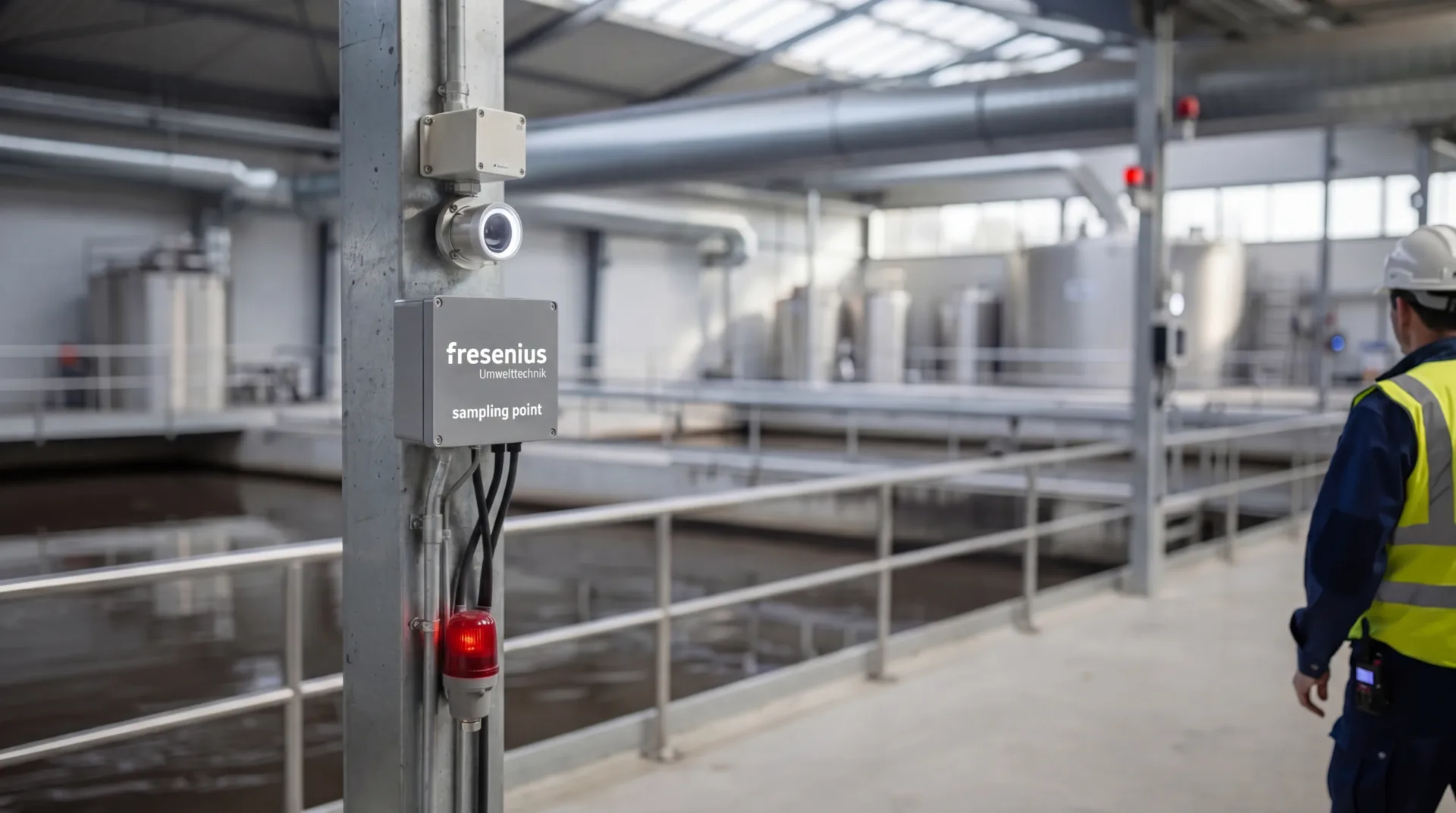
- Sampling probe in the sludge hall with a coarse filter.
- ATEX-certified inline flame arrestor (EN ISO 16852) at the transition from the Ex zone to the safe area. It reliably prevents flame or ignition flashback.
- PTFE sample gas line with lengths up to 40 m. For humid sample gases, we additionally recommend a self-limiting sample gas trace heating system, which maintains the gas above the dew point and reliably prevents condensation.
- Universal sample gas filter (5 µm PTFE membrane) immediately upstream of the analyzer to protect against residual dust and aerosols.
- Climate-controlled technical room at 15–25°C, where the GA210 can be operated stably.
This concept cleanly separates measurement technology and the hazardous area – a foundation for plants operated according to GefStoffV § 6 and BetrSichV §§ 15/16.
Sample Gas Conditioning as the Key to Long-Term Stability
In a humid, dusty atmosphere, it is not the analyzer alone but the sample gas conditioning that determines the availability of the overall system.
Condensate Management
If moisture precipitates in the line, droplets form, causing pulsations and fluctuations in measured values. Optional trace heating of the PTFE line keeps the gas consistently above the dew point. If required, a sample gas cooler with a condensate separator can also be used.
Particle Retention
Dust from the sludge hall must never enter the NDIR measuring cell. We recommend a two-stage approach: a probe filter (approx. 100 µm) at the sampling point and the universal sample gas filter (5 µm) directly upstream of the analyzer. Maintenance intervals: quarterly inspection, semi-annual filter replacement.
Pressure Adjustment
The applied sample gas pressure must be within the compensation range of the analyzer (0.7–1.1 bar abs.). For sample gas pressures outside this range, the inlet pressure can be stabilized via flow resistances, bypass lines, or active pressure regulation.
Redundancy: Two Devices for Seamless Safety Monitoring
An occupational safety measurement in the LEL range must not allow any monitoring gaps – even during the daily automatic zero point adjustment. For safety-relevant applications, we therefore recommend a redundant design with two analyzers. While one device undergoes its adjustment (approx. 2 minutes), the second takes over the measurement seamlessly. This concept significantly increases availability and additionally allows for plausibility checks of the measured values during operation.
The 4–20 mA analog outputs of both devices can be connected to the higher-level safety PLC, including pre-alarm and main alarm thresholds – typically at 20% LEL (0.88 vol.% CH₄) and 40% LEL (1.76 vol.% CH₄). If exceeded, ventilation measures are automatically activated or processes are stopped.
Standards and Regulations: Legally Compliant Implementation
The design and operation of methane monitoring systems in sludge halls and comparable areas of the chemical industry are subject to strict legal requirements:
- TRGS 720: Hazardous explosive atmospheres – General aspects.
- TRBS 2152 Part 1 / TRGS 721: Hazardous explosive atmospheres – Assessment of the explosion hazard.
- BetrSichV §§ 15/16: Testing of systems requiring monitoring before commissioning and recurringly.
- GefStoffV § 6: Information gathering and risk assessment for activities involving hazardous substances.
- EN 60079-29-1: Gas detectors – Performance requirements of detectors for flammable gases.
- EN ISO 16852: Flame arresters – Performance requirements, test methods and limits for use.
- ATEX Directive 2014/34/EU: Equipment and protective systems intended for use in potentially explosive atmospheres.
Fresenius Umwelttechnik supports you in the risk assessment and the creation of the explosion protection document in accordance with GefStoffV/BetrSichV. Please feel free to contact us!
Safety is a System Topic – Not Just a Sensor Topic
Reliable CH₄ monitoring in a sludge hall only succeeds if the measurement principle, sampling, sample gas conditioning, and plant integration are considered as a single unit. NDIR technology with targeted wavelength selection at 3.3 µm provides the selective, poisoning-free methane measurement that pellistor systems cannot deliver in H₂S-containing atmospheres. The combination of an inline flame arrestor, sampling line up to 40 m, and climate-controlled technical room enables safe operation of the analyzer outside the Ex zone. The extractive concept is no slower than in-situ pellistor systems – while offering significantly higher measurement reliability. And a redundant two-device concept ensures that monitoring is never interrupted, even during the daily zero point adjustment.
At Fresenius Umwelttechnik, we accompany our customers from risk assessment and sampling design to commissioning and long-term service. If you are planning resilient LEL monitoring for your sludge hall or a comparable application in the chemical industry, contact us – we will work with you to develop a concept that meets both normative requirements and your plant reality.
Frequently Asked Questions (FAQ)
Why is NDIR better than pellistor for methane in sludge halls?
NDIR sensors are selective for methane at a 3.3 µm wavelength and are not affected by H₂S, siloxanes, or oxygen deficiency. Pellistors can be poisoned by H₂S, require oxygen, and are non-specific towards combustible gases.
Which alarm thresholds are common for LEL monitoring?
Pre-alarm at 20% LEL (0.88 vol.% CH₄) and main alarm at 40% LEL (1.76 vol.% CH₄). If exceeded, ventilation measures are activated or processes are stopped.
Does the gas analyzer have to be ATEX-certified?
Not with extractive sampling. The analyzer is installed outside the Ex zone. An ATEX-certified inline flame arrestor (EN ISO 16852) at the zone transition is decisive.
How often does the GA210 need to be calibrated?
The GA210 automatically performs a zero point adjustment with ambient air once a day – duration approx. 2 minutes, fully automatic or externally triggerable via PLC. Additionally, we recommend a regular span gas check – the interval depends on operational safety requirements.
Is the extractive system fast enough for LEL monitoring?
Yes. The analyzer Tₐ₀ is approx. 3 seconds. Even with a 40 m sampling line and the powerful internal pump (4 l/min), the system response time remains well under 30 seconds – thus comfortably meeting the requirements of EN 60079-29-1. For comparison: in-situ pellistor sensors have typical Tₐ₀ times of 10–30 seconds but offer no selectivity and no H₂S resistance.
What sample gas conditioning is necessary?
Indispensable: PTFE sample gas line (up to 40 m), two-stage filtering (probe filter + sample gas filter), and ATEX flame arrestor. For high humidity, we recommend sample gas trace heating. Optionally, a sample gas cooler with a condensate separator can be used.
How quickly does the system react to a methane increase?
In a large-volume sludge hall, the CH₄ concentration increases over minutes, not seconds, even during a sudden outgassing event. The system response time of the GA210 extractive system is between a few seconds and a maximum of approx. 20 seconds (with a 40 m line) – thus the system detects a concentration increase long before a critical level is reached.