



Smart Series: Oxygen Analyzers and Compact Gas Analysis
The most compact and versatile gas analysis solution on the market
Powerful, space-saving and flexible.
Products in this series
Individually adaptable to your needs


Which oxygen analyzer suits your measuring point?
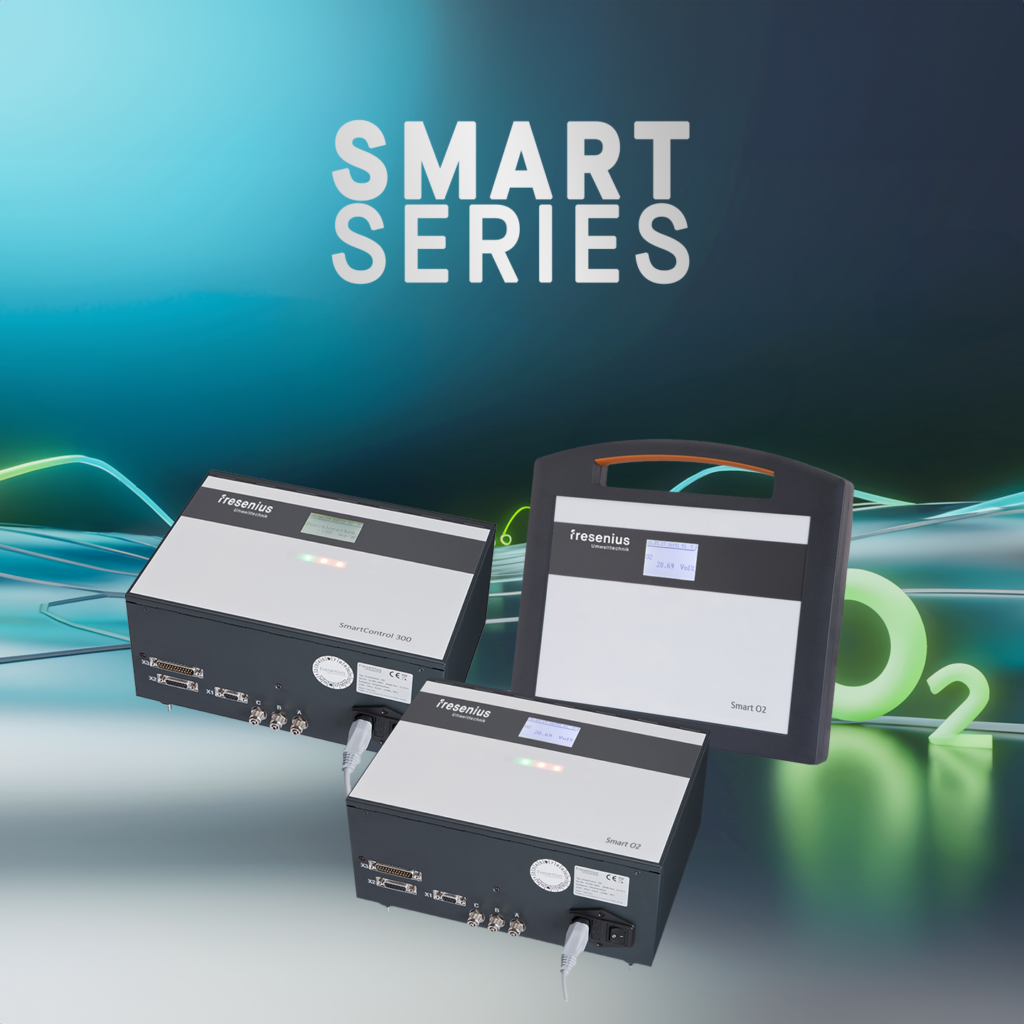
The Smart Series from Fresenius Instruments stands for reliable gas analysis in a particularly compact design. This series comprises three devices: the Smart Control 300, the Smart O2 and the Smart O2 Portable. All models offer precise measurements and have been specially developed for applications where space saving and flexibility are paramount. With the Smart series, you get state-of-the-art gas analysis technology that can be easily integrated into your processes thanks to its compact design, without compromising on performance.
Advantages

Cost efficiency through low-maintenance operation
The Smart Control 300 corrects its zero point automatically and without test gas — this applies to the NDIR method and noticeably lowers running costs there, because test gas cylinders have to be procured and replaced far less often. The two Smart O₂ instruments use a zirconium oxide sensor that needs no consumables. Both keep maintenance effort low.

Versatility for different applications
The Smart Control 300 works with a single-beam NDIR method and a heated cuvette, monitoring threshold concentrations of infrared-active gases. The two Smart O₂ instruments measure oxygen via a zirconium oxide sensor. Together the series covers two measuring tasks — from use in the biogas industry to refrigerator recycling.

Simple integration and operation
The compact design and the interfaces enable seamless integration into existing systems: RS232 is standard, while Profibus DP, Ethernet Modbus TCP, Ethernet IP and Profinet are available as options. The user-friendly 128 x 64 touch display makes operation intuitive and ensures fast and reliable monitoring of your gases.
Frequently asked questions
What is an oxygen analyzer?
An oxygen analyzer continuously determines the oxygen content of a gas stream and outputs it as a reading — in percent by volume or ppm. This means measurement in the process gas, not blood oxygen saturation; that is the domain of pulse oximeters, which have nothing to do with gas analysis.
Which measurement principle does the Smart O₂ use?
A zirconium oxide sensor. A heated ceramic cell generates a voltage between sample gas and reference air that depends on the oxygen content. The method needs no consumables — unlike electrochemical cells, which are wear parts and have to be replaced regularly.
How accurate is the Smart O₂?
The measurement deviation is ± 0.5 % of full scale. The ranges 0 – 5 vol.-%, 0 – 25 vol.-% and 5 – 95 vol.-% are available; the range is specified for the measuring task, because accuracy relates to full scale.
What is the difference between Smart O₂ and Smart O₂ Portable?
The measurement technology is identical. The Portable is battery-powered — up to 8 hours of operation, 3 hours of data storage, connected via a 6/4 quick coupling for spot measurement. The stationary Smart O₂ runs on mains power and can be extended from one to up to four sample gas inlets.
How many measuring points can I connect?
The Smart O₂ has one sample gas inlet as standard and can be extended to up to four measuring points. The Smart Control 300 has one measuring point as standard and up to three channels.
What is the Smart Control 300 for?
For monitoring threshold concentrations. It works with a single-beam NDIR method and a heated cuvette at 50 °C, achieves an accuracy better than 5 % of the reading and responds in about 20 seconds. It does not measure oxygen but infrared-active gases — complementing the two oxygen instruments in the series.
How quickly is a Smart Series instrument ready for use?
The Smart Control 300 reaches full specification after about 30 minutes; the exact figure depends on the substance being measured. This applies to any instrument with a heated measuring cell — the cell first has to reach operating temperature.
Why is the series called “Smart”?
Because of the form factor. All three instruments sit in the same compact housing of 310 × 133 × 221 mm and fit where there is no room for a 19" rack unit. Anyone who has to capture several components at once, or work with large measuring ranges, is better served by the analyzers of the GA series.
Not sure which device fits?
Tell us about your application — we will advise you holistically and solution-oriented.