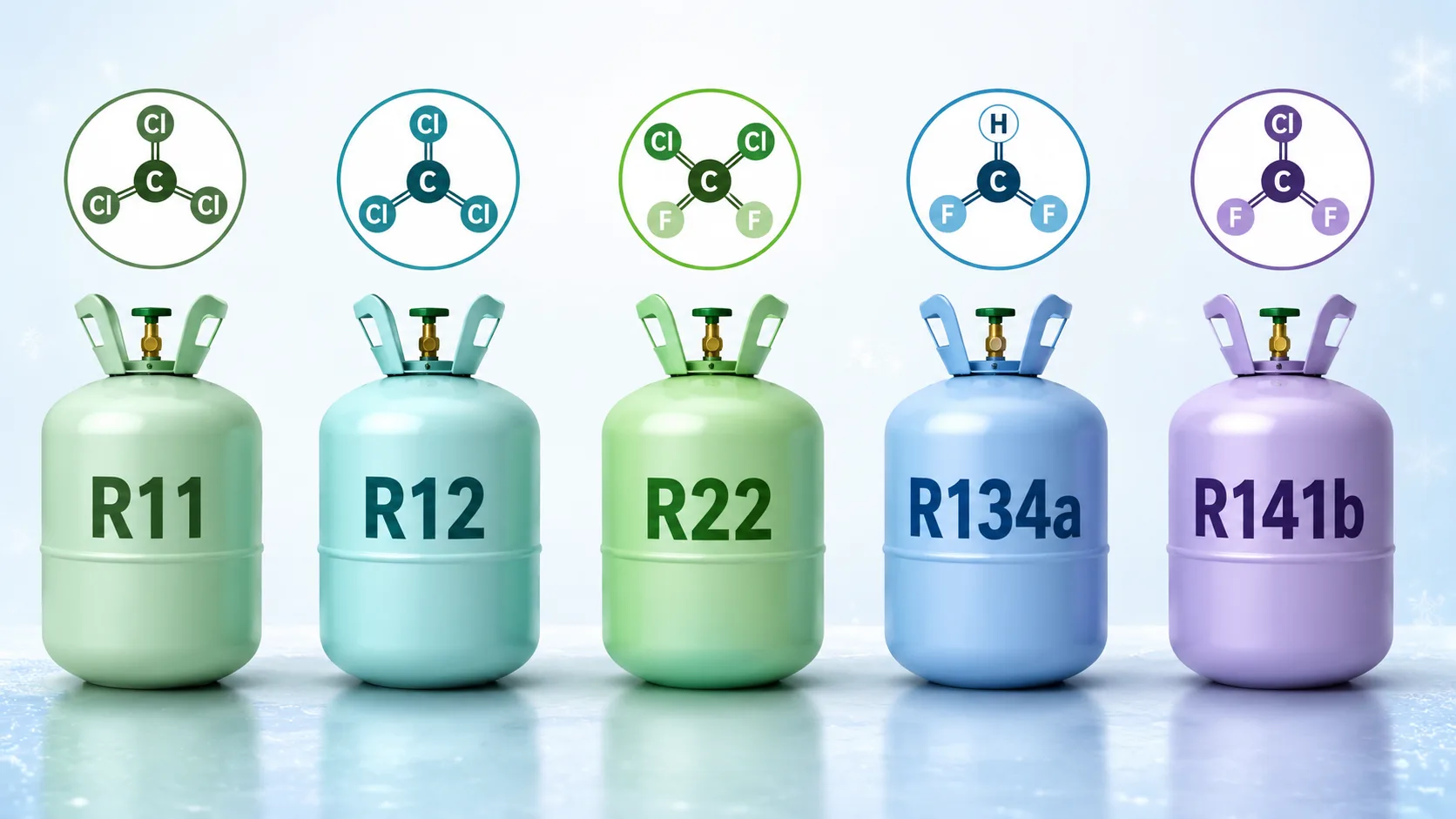
In brief: Calibration gases based on refrigerants R11, R12, R22, R134a, and R141b will become significantly more expensive and less available in the coming years. The reason lies not with us or our suppliers, but with international and European law: the Montreal Protocol, the Kigali Amendment, and the EU F-Gas Regulation continue to restrict the production and import of these substances year after year. Operators of equipment for refrigerant detection or calibration – for example, in refrigeration appliance recycling – should factor this development into their budget and procurement planning early on.In this article, we explain which refrigerants are affected, why this is the case, and what concrete steps you can take to avoid being without calibration gas at short notice.Most Important First: What Changes for YouRefrigerantCurrent SituationTrendR11 / R12No new production worldwide since 2010 at the latest – only old and recycled stocks remainStocks continuously decreasing, price increasingR22New production in EU/USA ended since 2020, only reclaimed (recovered) goodsIn the USA, already $150–300/lb in 2026 – many times the price before 2020, continuing to riseR141bVirtually no new production in industrialized countries, only importable from countries like ChinaDependence on a few non-European manufacturers is growingR134aNo ban, but an annually decreasing EU quantity quotaEU quota fee will drive prices up by around 10% in 2026, with a continuing upward trend until 2030For you as an operator of gas measuring devices, this specifically means: Calibrations will become more expensive in the medium term because the required calibration gas itself is more costly and complex to procure. For most customers, we handle this procurement as part of the calibration – the rising raw material costs are then reflected in the calibration costs. If you procure your calibration gas yourself, you will be directly affected by longer lead times, rising prices, and in individual cases, additional import requirements.Why are these refrigerants becoming scarcer?R11, R12, R22, R134a, and R141b are among the most strictly regulated industrial chemicals worldwide. Three regulatory frameworks intertwine here:Montreal Protocol (1987): regulates the complete cessation of production for CFCs like R11 and R12, as well as the phased elimination of partially halogenated HCFCs like R22 and R141b. A distinction is made between industrialized countries (Article 2 Parties) and developing countries (Article 5 Parties – including China, large parts of Latin America, Africa, and Asia), which have longer transition periods.Kigali Amendment (2016): extends regulation to hydrofluorocarbons (HFCs) like R134a and mandates a gradual reduction until 2036 (industrialized countries) or 2045 (developing countries).EU F-Gas Regulation (VO (EU) 2024/573): implements the Kigali requirements more strictly and quickly within the EU – including through an annually decreasing quantity quota for HFCs and sector-specific usage bans.The effect is the same for all five substances: less legally available new goods meet constant or even growing demand – for example, for the calibration of measuring devices used in the professional recycling of old refrigeration appliances. This drives up prices.The Five Refrigerants at a GlanceRefrigerantSubstance ClassODP*GWP** (100 yr.)Boiling PointMain ApplicationR11 (CFC-11)CFC1,0~4,75023.8 °CRefrigeration systems, foam blowing agents (historical)R12 (CFC-12)CFC1,0~10,900−29.8 °CRefrigeration/air conditioning systems, propellantR22 (HCFC)HCFC0,055~1,810−40.8 °CAir conditioning systems, refrigeration systemsR134a (HFC)HFC0~1,430−26.3 °CVehicle air conditioning, refrigeration systems, metered-dose inhalersR141b (HCFC)HCFC0.11–0.12~725–80032.0 °CPU foam blowing agents, precision cleaners*ODP = Ozone Depletion Potential (relative to R11 = 1.0) · **GWP = Global Warming Potential (relative to CO₂ = 1)The higher the ODP and GWP, the stricter the regulation, as a rule – this explains why R11 and R12, as fully halogenated CFCs, are disappearing most consistently from the market, while the ozone-friendly R134a is “only” being restricted via a quantity quota.Regulatory Status 2026 in ComparisonRefrigerantIndustrialized Countries (Art. 2 Parties)Developing Countries (Art. 5 Parties)R11 / R12 (CFC)Production banned since 1996Production banned since 2010R22 (HCFC)Production/import ended since 2020, only recycled goodsGradual reduction until complete phase-out in 2030R141b (HCFC)Use limited to recycled goods since 2015, new goods practically phased outGradual reduction until complete phase-out in 2030R134a (HFC)No ban, but EU quota system with decreasing annual quantity until 2050Kigali Amendment: slower reduction path until 2045In practice, this means: new R141b goods are currently almost exclusively available from countries like China, which also export to Latin America, the Middle East, and Southeast Asia. For R11, R12, and R22, there is no new production in industrialized countries at all – every kilogram of recycled goods counts here.What This Means for Your CalibrationGas measuring devices used in the professional recycling of old refrigeration appliances must be regularly calibrated with defined test gas concentrations of the respective target substance. For most customers, we handle this calibration, including the provision of the appropriate calibration gas – thus, the procurement of the underlying pure substance is our responsibility, but we pass on rising raw material costs directly in the calibration costs. Because specialized test gas manufacturers are increasingly no longer stocking these niche refrigerants as standard products, the pure substance is more and more frequently required directly as a raw material for the production of corresponding calibration gases – with noticeable consequences:Rising raw material costs: Pure substances are increasingly only available from Article 5 Parties or from shrinking recycled stocks.Longer lead times: Specialized pure substance suppliers calculate small quantities individually and generally do not maintain stock.Increased regulatory effort: The import of R11, R12, R22, and R141b as pure substances into the EU may require approval or registration.Concentration risk: As the number of manufacturers decreases, dependence on individual suppliers increases.If you procure your calibration gas yourself rather than through us, these four points will affect you directly and fully. An exception in any case is R134a: its availability as a calibration gas precursor is expected to remain secure in the medium term – the cost increase primarily results from the EU quota fee, not from a fundamental supply bottleneck.What You Can Do NowProcurement will not become impossible overnight – but it will become noticeably more complex, slower, and more expensive. Those who plan early will not be caught by surprise:Plan and book calibrations early: The sooner we know your needs, the better we can procure the appropriate calibration gas in time.Adjust budget: Already factor rising calibration costs for R11-, R12-, R22-, and R141b-based applications into your planning.For self-procurement – diversify suppliers: If you procure calibration gas yourself, qualify multiple sources in parallel to avoid dependence on a single supplier.For self-procurement – clarify regulations in advance: Check import and usage regulations for the respective pure substance early, rather than discovering them only when ordering.Keep alternative testing methods in mind: Where possible, reduce dependence on phasing-out substances early.ConclusionR11, R12, R22, R134a, and R141b are in different, but clearly recognizable, phases of a regulatory-driven phase-out process. For you as a customer, this primarily means one thing: calibrations based on these substances will become directly more expensive as soon as the underlying raw material costs rise, and for R11, R12, R22, and R141b, the calibration gas itself will also become noticeably harder to procure. The sooner you plan your calibration needs with us, the better we can estimate dates and costs – although we cannot stop the price development itself.Would you like to know how this development specifically affects your next calibration? Contact us – we will advise you on availability, lead times, and alternatives for your application.Status: September 2026. This article summarizes publicly available information on refrigerant regulation and serves for general classification; it does not replace individual legal or professional advice.
Request service
Services
- Maintenance Preventive inspection · filter service · performance test
- Repair On-site & workshop · certified refrigeration · lab diagnostics
- Commissioning & calibration Installation · factory calibration · maintenance & operator training
- Spare parts (10+ years) Guaranteed availability · original parts
Our promise
- 24–48 h response time Worldwide on-site service
- Mail-in repair service Loan devices available — no production downtime during maintenance or repair
- 30+ year device lifespan Premium components made in Germany
- Cloud Connect ready Cellular telemetry from the factory
- ISO 9001:2015 certified Audited service processes
 Blog · Process Biomethane Feed-in into the Natural Gas Grid: How Precise Gas Analysis Supports Quality Assurance and Grid Injection Secure Biomethane Feed-in Thanks to Precise Gas Analysis: Fresenius Umwelttechnik's fast online process analytics continuously monitors relevant accompanying… 07. Oct 2026
  Blog Gas Analysis in Recycling: Efficient Process Control and Emission Monitoring in Waste Recovery From Waste to Raw Material: Precise Gas Analytics for the Recycling Revolution. Waste becomes energy – but highly… 10. Sep 2026
  Tipps Refrigerant Calibration Gases Are Becoming More Expensive and Scarcer: What You Need to Know Now In brief: Calibration gases based on refrigerants R11, R12, R22, R134a, and R141b will become significantly more expensive… 03. Sep 2026
  Tipps New EU Requirements for Industrial Emissions: What Operators Need to Know Now With the revised Industrial Emissions Directive (IED 2.0, Directive (EU) 2024/1785), the European Union has significantly tightened the… 13. Aug 2026
 Company
Career & Events

Get in touch
Jedes Vol.-% CH₄ ist Geld wert. BioBasic — präzise Biogas-Analyse, Made in Germany.

Measuring What Matters
GAS ANALYZERS · MADE IN GERMANY · SINCE 1848