


Important note on emissions monitoring: Switchover is not permitted for legally required continuous emissions monitoring. Here, a dedicated sample gas inlet without switchover is used to guarantee seamless measurement data.Cost comparison: Investment versus ongoing maintenance 1. Acquisition and installation (CAPEX)In-situ systems often seem cheaper for a single measuring point, as sampling lines and gas coolers are not required. However, costs increase with each additional measuring point, as each point requires its own measuring unit. An extractive analyzer, on the other hand, can be connected to several points via a multi-point sampling system, thus reducing the cost per measuring point.2. Operation and maintenance (OPEX)Extractive systems require regular maintenance of filters and gas coolers to prevent contamination and condensate. In-situ sensors are mechanically low-maintenance but can degrade with aggressive gases; replacing a sensor directly on the duct is then often complex, as is cleaning dirty optical windows.3. Calibration effort and downtimeExtractive systems traditionally require periodic recalibration, sometimes with expensive test gases; in-situ laser systems often calibrate themselves via integrated reference cells. This is exactly where the NDIR analyzers from Fresenius Umwelttechnik come in, covering two NDIR methods depending on the application, measuring range, and measurement wavelength:NDIR methodCalibration effortDual-pressure reference methodSelf-referencing – no zero or test gases requiredDual-beam with reference detectorThanks to optimized characteristic curve evaluation, usually only regular zero point correction is needed; an end point calibration is only required in special casesThis self-referencing is a feature of the NDIR dual-pressure technology. It does not apply to other measurement principles – such as NDUV, paramagnetic, or zirconium oxide oxygen measurement; there, the respective principle-specific adjustment remains necessary. The calibration advantage thus noticeably reduces the ongoing operating costs of extractive NDIR systems without completely replacing the basic effort.Decision aid: Which method wins in your plant?In-situ gas analysis pays off primarily when very fast response times in the second range are required or when a clean gas is to be detected at a single, easily accessible measuring point.Extractive gas analysis shows its strengths as soon as aggressive, moist, or hot gas mixtures must be conditioned in a controlled manner or when high-precision multi-gas analyses (NDIR or NDUV) are required – with several components per measuring point and several measuring points served cyclically. A dedicated sample gas inlet is used for continuous emissions monitoring.The mix of gas matrix and measuring points is decisiveThere is no general “better” – only a “more economical for your specific process”. Those who know the gas matrix of their sample gas and strategically plan the number and accessibility of the measuring points will make a sustainable decision. In-situ scores on speed and individual measuring points, extractive on demanding gas matrices, multi-gas analytics, and multiple measuring points.Are you unsure which method will sustainably reduce your operating costs? Contact the application experts at Fresenius Umwelttechnik – we will analyze your process and work with you to find the technically and economically suitable solution.Frequently Asked Questions (FAQ)What is the difference between in-situ and extractive measurement?In in-situ measurement, the analyzer is located on the duct and measures directly in the process gas without sampling. In extractive measurement, a sample is taken, conditioned (filtered, dried, temperature-controlled), and measured in a separate analyzer.How many measuring points can an extractive analyzer monitor?Up to eight process points can be served in automatic rotation via an internal measuring point switchover – cyclically one after the other, not simultaneously. A dedicated inlet is used for an emissions measuring point that must be monitored continuously.Does an extractive system need expensive test gases?That depends on the measurement principle. With the NDIR dual-pressure reference method, the system is self-referencing and does not require zero or test gases. With the NDIR dual-beam method, a regular zero point correction is usually sufficient, with end point calibration only in special cases. For NDUV or oxygen measurement, the respective principle-specific adjustments apply.Which method reacts faster?In-situ laser systems provide measured values in about two seconds because the gas is not transported. Extractive systems are typically in the range of about 20 to 40 seconds, including transport time.Which method is suitable for emissions monitoring?Since emissions monitoring must be continuous, a dedicated sample gas inlet without measuring point switchover is used. Whether in-situ or extractive is the appropriate method depends on the gas matrix, required accuracy, and process conditions.
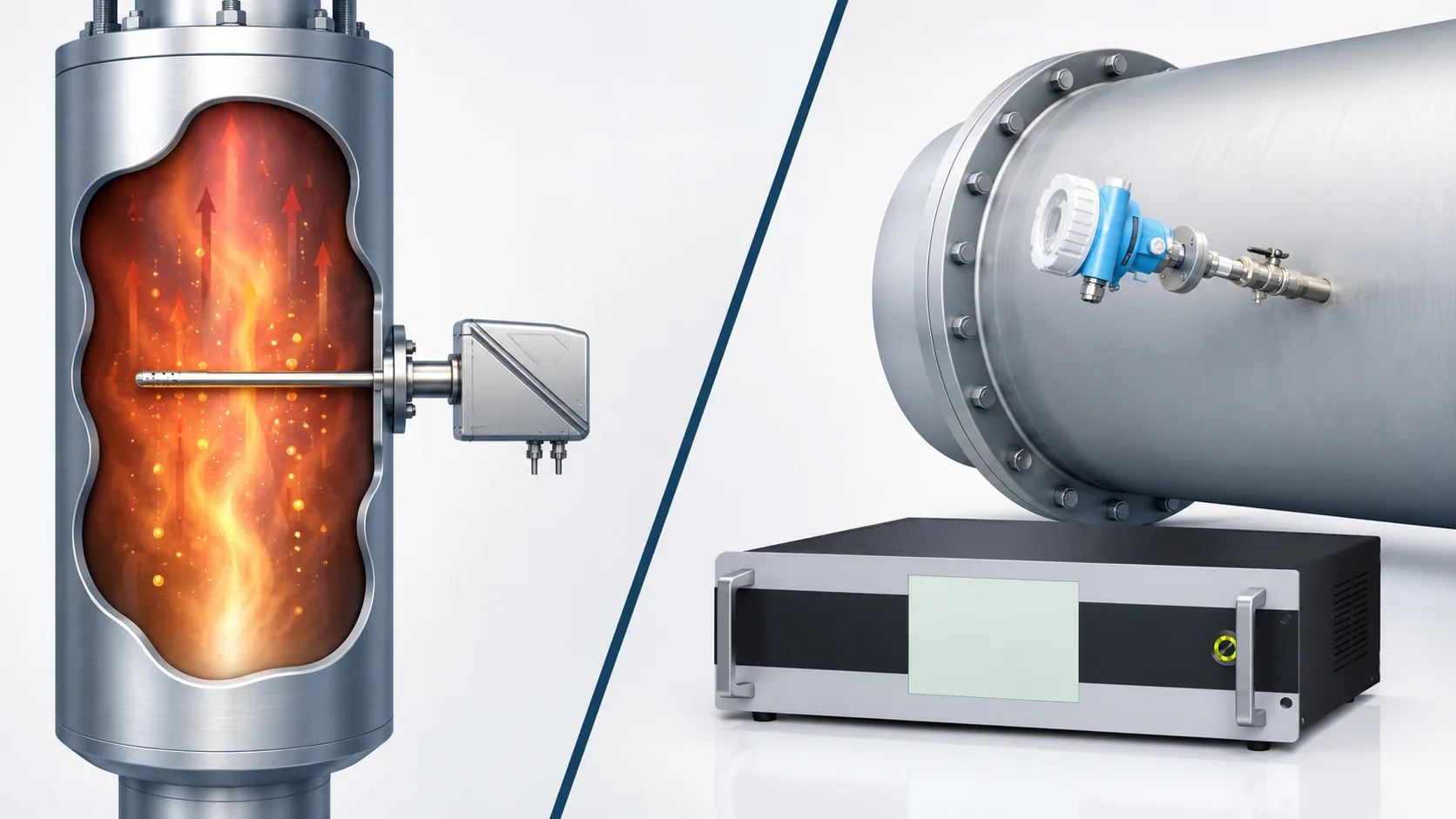
The continuous monitoring of process gases is a central building block for efficiency and plant safety in chemistry, biogas production, and emissions monitoring. Before installation, however, a fundamental directional decision must be made: Should measurements be taken directly in the process stream (in-situ) or via sampling (extractive)? Both paths have clear strengths – and cause different investment and operating costs. Which method is economically viable in which application? Inline Gas Analysis: Direct measurement in the process streamIn in-situ analytics, the sensors or optics are located directly on the duct or chimney. The gas is measured with rapid response times without leaving the process. State-of-the-art optical methods – such as Tunable Laser Diode Spectroscopy (TDLAS) – send their light signal across the flowing gas stream for this purpose.This is to be distinguished from inline measurement, where the measuring cell is located in a bypass line through which the gas flows. Both methods have one thing in common: they measure non-extractively, which means external gas conditioning is not required.The most important advantages of in-situ gas measurement Real-time measured values: The data is available with almost no time delay.Low effort: No complex conditioning necessary, as the medium remains directly in the process.High temperature resistance: Utilizing the process temperature enables reliable measurements even with hot and moist gases.Limits and challenges of the technology Difficult calibration: Calibration and validation work must be carried out directly at the measuring location, which is often difficult to access.Signal attenuation: Heavy dust development or turbidity in the gas stream can attenuate the signal.Maintenance effort: Optical windows become dirty and require regular cleaning and adjustment.Precise alignment: The transmitter and receiver units must be exactly aligned across the measuring path.Component limitation: Usually only one measurement component per measuring path can be detected, with an overall limited selection of measurement methods.Extractive Gas Analysis: Precision through controlled gas conditioningThe extractive method follows a reliable approach to gas characterization: a sample gas pump continuously takes a representative sample directly from the process. Before the actual gas analysis takes place, the medium is conditioned via heated lines and efficient gas coolers – meaning it is specifically cleaned, dried, and brought to a stable temperature.Only then does the gas enter the gas analyzer (such as the compact Smart Series or the Gas Analyzer 320 from Fresenius). The great advantage of this controlled environment in the measuring cell: interference factors such as moisture or particles are reliably eliminated, which guarantees extremely stable and precise measured values.Economic advantage: Efficient measuring point switchoverA central advantage of the extractive approach is the measuring point switchover:Cost reduction: A single gas analyzer can serve up to eight process points in automatic rotation via internal solenoid valves.Multi-component analysis: Several gas components are detected simultaneously at each individual measuring point.Cyclic measurement: Detection takes place sequentially (one after the other, not simultaneously), which drastically reduces hardware costs per measuring point in complex plants.