




Process measurement
Gas Coolers in Gas Analysis: Purpose, Technology, Selection
A gas cooler lowers the dew point of the sample gas before it reaches the analyser. How that works, what matters in the heat exchanger and which of the three RCI models suits your measuring point.
- 175+years of experience in analytics
- Made in Germanydeveloped and built in Herten
- 10+ yearsspare parts supply for our instruments
Products
Our Products
-
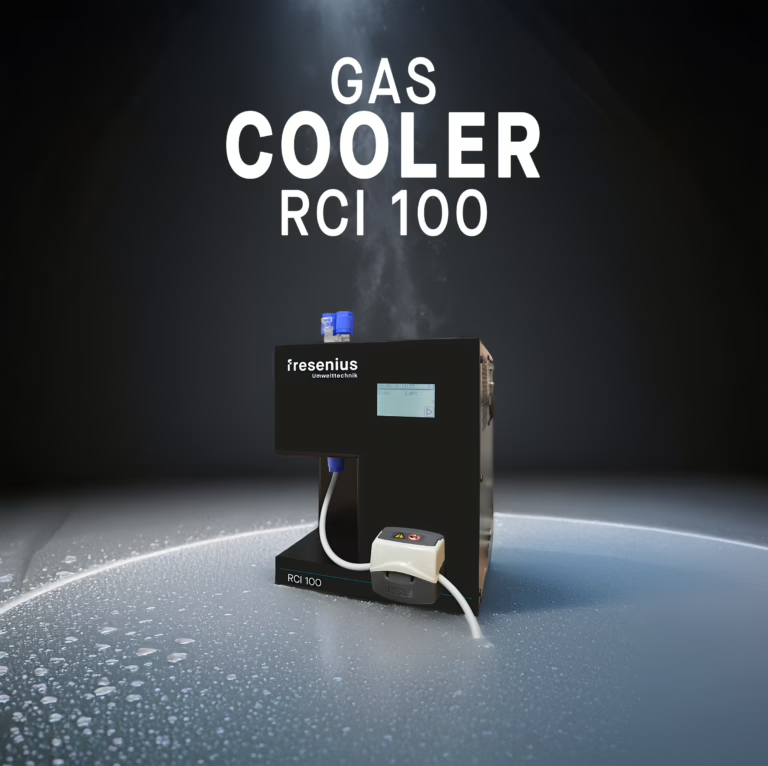 Wall-mounted Gas Cooler RCI 100 Compact gas cooler in wall-mounted housing with Duran glass heat exchanger Learn more
-
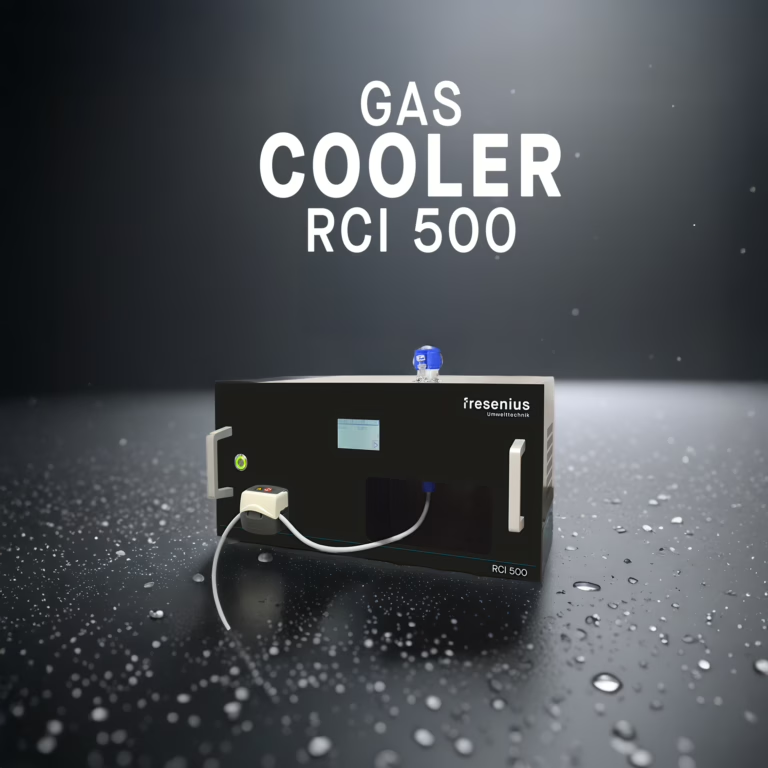 Compact Gas Cooler RCI 500 Compact 19" gas cooler with 0.86 vol.-% residual moisture Learn more
-
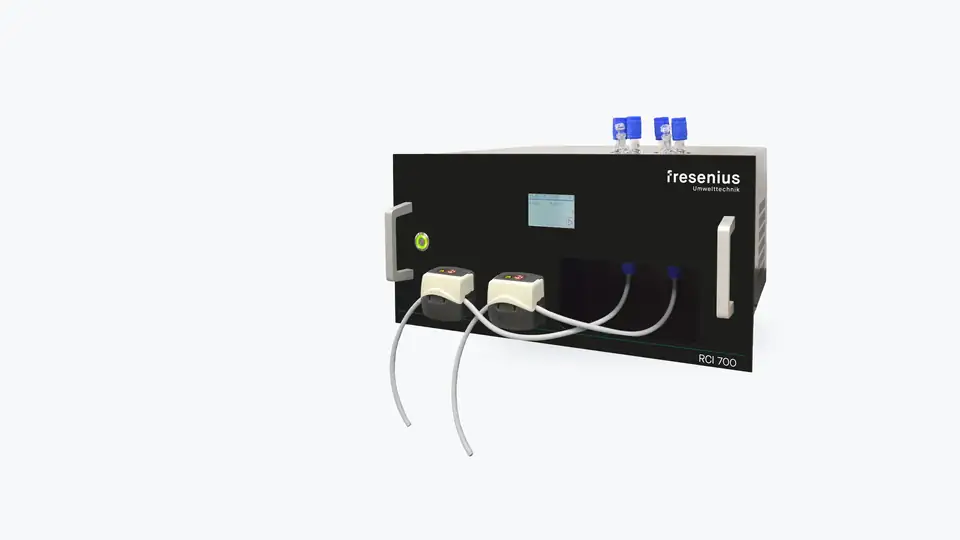
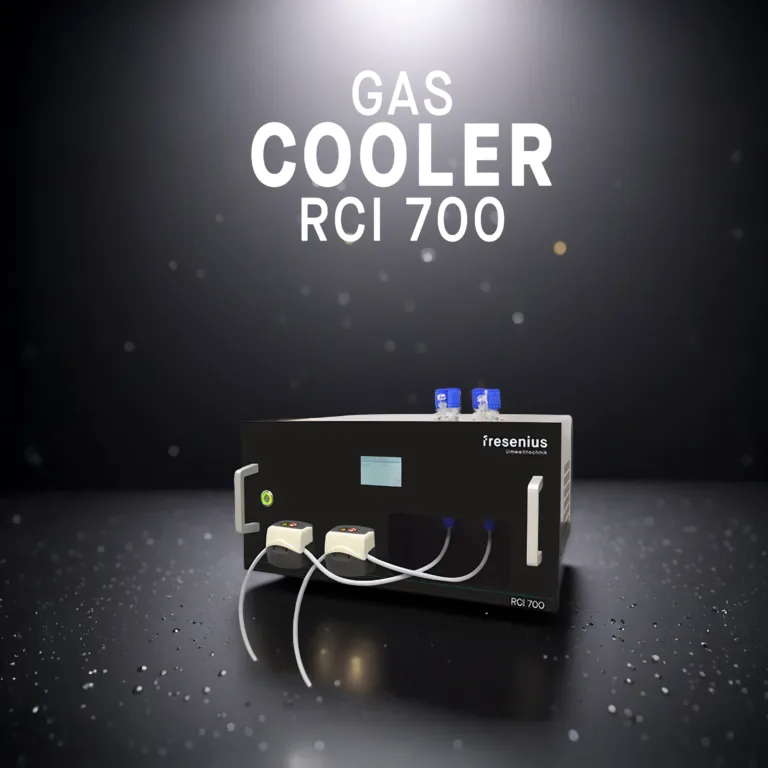 2 Streams Gas Cooler RCI 700 Gas cooler for two measurement gas streams with Duran glass heat exchanger Learn more
Overview
What a Gas Cooler Does in Gas Analysis
The term gas cooler is used in two entirely different fields: in refrigeration for heat exchangers in cooling systems – and in gas analysis for the device that removes moisture from the sample gas before it reaches the analyser. This page covers the second case.
A gas cooler is one of the most frequently underestimated components in gas measurement technology – yet its performance directly determines the quality of your analysis results. Moist or particle-laden sample gas causes condensation in the analyzer, leads to corrosion, falsifies measurement values and can result in expensive repairs. The RCI series gas coolers from Fresenius Instruments eliminate this risk by cooling the sample gas to a defined dew point temperature of 5 °C, achieving a residual moisture of just 0.86%.
The heart of every RCI gas cooler is the Duran glass heat exchanger: Duran borosilicate glass is highly corrosion-resistant and chemically inert to aggressive process gases such as SO₂, HCl or HF. Unlike metallic heat exchangers, it does not alter the sample gas composition through catalytic reactions – a decisive advantage for the accuracy of downstream analyzers such as the GA220 or GA210.
The RCI series comprises three models for different application scenarios: the RCI 100 is a compact gas cooler in a wall-mounted housing. The RCI 500 is the standard gas cooler in 19-inch rack format for CEMS installations and stationary process measurement. The RCI 700 cools two sample gas streams simultaneously – ideal for plants with redundant measurement channels or parallel measurement points.
All RCI gas coolers are manufactured in Germany, designed for low maintenance and benefit from the 10+ years spare parts supply from Fresenius. Combined with our sampling systems and gas analyzers, you receive a complete measurement chain from a single source – from gas extraction through conditioning to analysis.
Contact
How to get to the right measuring solution
Two ways lead to the same goal. Get in touch with us directly – or complete the technical information form first.
FAQ
Frequently Asked Questions
Is a gas cooler the same as a gas cooler in refrigeration?
No. In refrigeration the term refers to a heat exchanger that cools a refrigerant back down. In gas analysis a gas cooler is a conditioning device in the sample gas path: it cools the sample gas to a defined dew point so the moisture condenses out before the analyser. The two have nothing in common but the name.
Why do I need a gas cooler?
A gas cooler removes moisture from the sample gas to prevent condensation in the analyzer and ensure measurement accuracy. It is essential for reliable gas analysis.
What is the difference between RCI 100, 500 and 700?
The RCI 100 is a compact gas cooler in a wall-mounted housing, the RCI 500 is the standard gas cooler for rack mounting, and the RCI 700 can cool two sample gas streams simultaneously.
Why do you use Duran glass in the heat exchanger?
Duran glass is highly corrosion-resistant, chemically inert and durable. It does not react with the sample gas and does not alter its composition.
What residual moisture do your gas coolers achieve?
Our RCI series gas coolers achieve a residual moisture of 0.86% at a dew point temperature of 5°C – optimal for precise gas analysis.
Measuring principle
How the measurement works
From Process to Analysis – How Gas Measurement Works
Advantages
Our Service Advantages
Service and support from Fresenius Instruments – with over 175 years of experience in analytical chemistry.
Coordinated Service Visits
Urgent cases with production downtime are given priority. A maintenance contract sets fixed service intervals.
Dedicated Contact Person
Your personal service technician knows your devices and their history. This means problems are identified faster and resolved in a targeted manner – without lengthy familiarization.
Worldwide Field Service
Experienced service technicians deployed across Europe. Whether industrial plant, wastewater treatment or biogas facility – we come to you.
Experienced Technicians
Highly qualified service technicians with years of experience in gas measurement technology. Regularly trained on the latest technologies and procedures.
Remote monitoring
Remote Diagnostics with Cloud Connect Kit
Our Cloud Connect Kit enables remote monitoring of your devices via mobile network. Faults are automatically detected and reported – for fast diagnosis and minimal downtime.

Quality
Premium Components & Spare Parts Supply
High-quality suppliers primarily from Germany. 10+ years of spare parts supply. Maintenance and repair from a single source.
Longevity & Accuracy
With regular maintenance and calibration, your instruments measure reliably year after year. Measurement accuracy is as specified in the datasheet of each instrument.
Spare Parts 10+ Years
Long-term supply security with spare parts supply for over 10 years. No production downtime due to missing spare parts.
Investment Protection
Regular professional maintenance preserves the performance of your instruments and extends their service life. This lowers the total cost of ownership over the entire lifecycle.
Substances
Over 120 Measurable Substances
From standard gases to exotic compounds – our analyzers cover a wide spectrum.
Advice
Chat with Tory – Your Personal Product Advisor
Our AI Tory advises you on our analyzers, gas coolers, and sampling systems. Ask questions about products, applications, and receive a non-binding quote – around the clock.
Simply click on the chat in the bottom right corner of the screen.

About us
About Fresenius Instruments
As the successor to Carl Remigius Fresenius's Institut Fresenius, Fresenius Instruments draws on more than 175 years of experience in chemical analytics. We specialize in the measurement and continuous analysis of over 120 substances, employing methods including NDIR, EC, NDUV, zirconium oxide, paramagnetic measurement, and TDLAS for extractive process measurement. This longstanding tradition of innovation forms the foundation of everything we do.
