


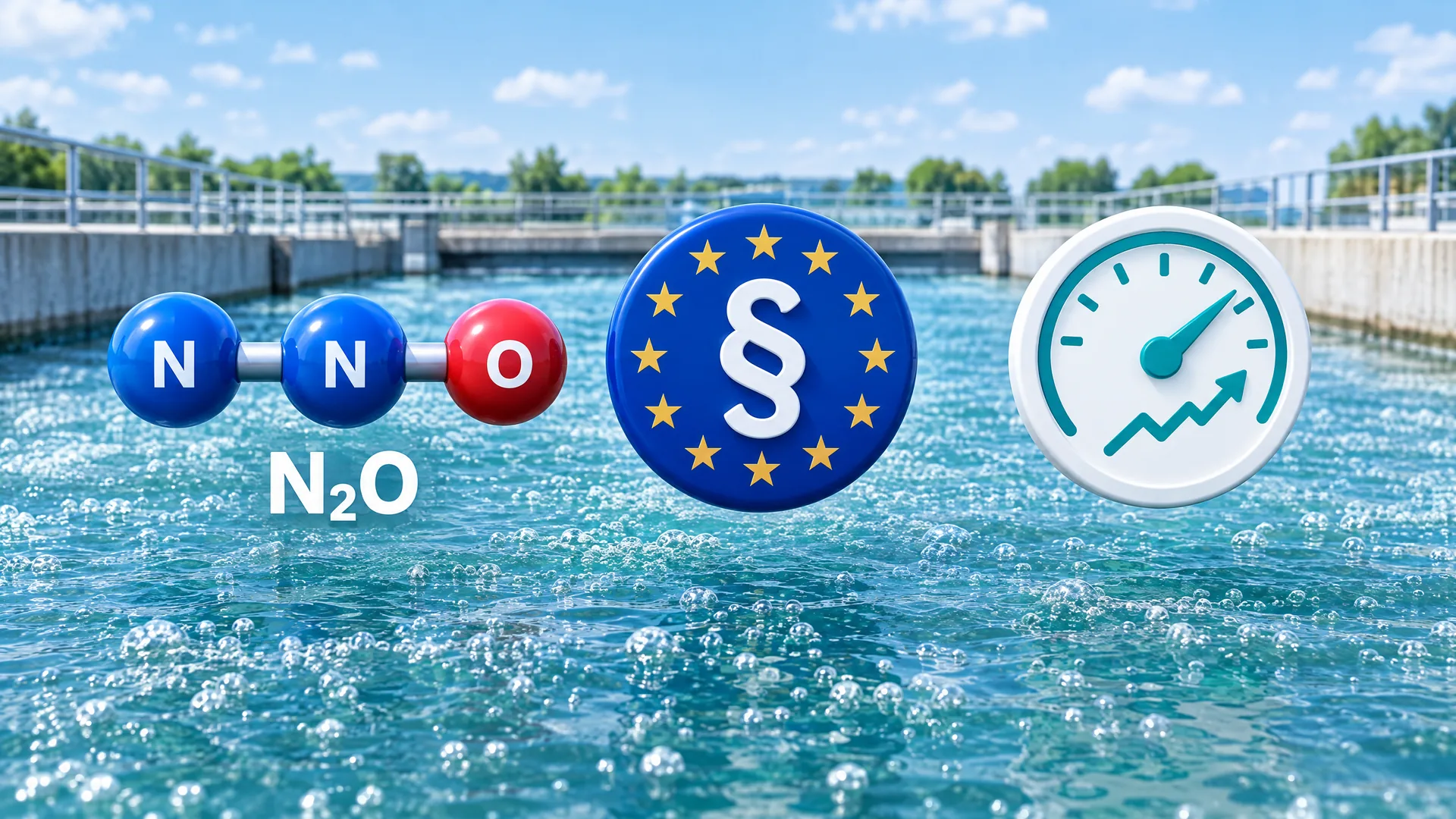
The new Urban Wastewater Treatment Directive (UWWTD) puts nitrous oxide on the agenda of every larger treatment plant: EU member states must monitor the greenhouse gases CO₂, methane and nitrous oxide (N₂O) of all treatment plants of 10,000 population equivalent and above. Germany must transpose the directive into national law by July 31, 2027. Read here what the directive requires, which deadlines apply, and why reliable figures only come from measurement.
Briefly answered: What does the Urban Wastewater Treatment Directive require for nitrous oxide?
Under Article 21 of Directive (EU) 2024/3019, member states monitor the greenhouse gases of all urban wastewater treatment plants of 10,000 population equivalent (p.e.) and above – at least CO₂, methane (CH₄) and nitrous oxide (N₂O). This may be done “through analysis, calculation or modelling, as appropriate”. However, a calculation with default factors can miss the actual emission many times over. Reliable figures for an individual plant – for reporting, the inventory and any reduction measure – only come from measurement.
Why nitrous oxide matters at treatment plants
Nitrous oxide forms in the biological treatment stage as a by-product of nitrogen removal – during nitrification and denitrification in the aeration tank. How much is produced depends heavily on operation: dissolved oxygen, aeration, nitrogen load and peak loads change the emission from hour to hour.
This is crucial for the climate balance. N₂O is about 273 times as potent as CO₂ (global warming potential over 100 years, IPCC AR6). Even small concentrations in the exhaust air of the aeration tank therefore carry weight. The Austrian Ministry of Environment states: Nitrous oxide is the determining share of greenhouse gas emissions at municipal wastewater treatment plants.
What the Urban Wastewater Treatment Directive regulates regarding greenhouse gases
The recast Urban Wastewater Treatment Directive entered into force on January 1, 2025. It replaces Directive 91/271/EEC on August 1, 2027, and, in addition to the fourth treatment stage and producer responsibility, introduces climate targets for wastewater treatment for the first time:
- Monitoring of greenhouse gases: At treatment plants of 10,000 p.e. and above, at least CO₂, CH₄ and N₂O are monitored – through analyses, calculations or modelling (Art. 21).
- Uniform methods: By July 2, 2027, the EU Commission will establish, by means of an implementing act, how direct and indirect greenhouse gas emissions are measured, estimated and modelled.
- National dataset: By the end of 2030, member states will report emissions for the first time per plant and per gas, then annually (Art. 22).
- Energy: An energy audit every four years, for the first time by the end of 2028 for plants of 100,000 p.e. and above. In addition, a national target for the entire sector: to generate as much renewable energy as the plants consume by 2045 (Art. 11).
Whether calculations will permanently suffice is an open question: In the evaluation by the end of 2033, the Commission explicitly examines requirements for actual measurements. Anyone who has only calculated until then will not have their own series of measurements to rely on.
Deadlines at a glance
| Date | What happens |
|---|---|
| 01.01.2025 | Urban Wastewater Treatment Directive (EU) 2024/3019 enters into force |
| 02.07.2027 | Commission implementing acts, including methods for greenhouse gases |
| 31.07.2027 | Deadline for transposition into national law |
| 01.08.2027 | Directive 91/271/EEC repealed |
| 31.12.2028 | First energy audits for plants of 100,000 p.e. and above |
| 31.12.2030 | First national dataset on greenhouse gases, then annually; energy target 20% |
| 31.12.2032 | First energy audits for plants of 10,000 p.e. and above |
| 31.12.2033 | Evaluation of the directive, including requirements for actual measurements |
| 2035 to 2045 | Energy target 40% (2035), 70% (2040), 100% (2045) – national, not per plant |
What applies in Germany today
The Wastewater Ordinance regulates the water path – effluent values for COD, nitrogen and phosphorus. So far, it contains no specifications for the gas emissions of biological treatment. The transposition of the Urban Wastewater Treatment Directive into the Water Resources Act and the Wastewater Ordinance is still pending.
Nevertheless, there is already a reporting obligation: treatment plants of 100,000 p.e. and above report according to the Pollutant Release and Transfer Register (E-PRTR) if they emit more than 10 t N₂O or 100 t CH₄ per year into the air. From the reporting year 2027, this will be done via the new European Industrial Emissions Portal (Regulation (EU) 2024/1244) – with the same thresholds. The value is usually determined via emission factors, and that’s exactly where the problem lies.
Calculate or measure? Why a calculation is not enough
Those who calculate multiply the nitrogen load in the influent by an emission factor: What proportion of the nitrogen escapes as N₂O? The IPCC standard value is 1.6%. However, its range extends from 0.016% to 4.5% – a factor of almost 300. A baseline from Danish measurement campaigns is 0.84%. A calculation example for a plant with 150,000 p.e. shows what this means:
| Assumption | Result |
|---|---|
| Nitrogen load (11 g N per p.e. and day) | approx. 600 t N per year |
| Emission factor 0.84% (baseline of Danish measurement campaigns) | approx. 8 t N₂O per year – below the reporting threshold |
| Emission factor 1.6% (IPCC 2019, standard value) | approx. 15 t N₂O per year – above the reporting threshold |
The same plant is therefore either below or above the reporting threshold depending on the factor – and its actual emission can deviate even further. A calculation thus answers neither whether your plant is subject to reporting, nor how much it actually emits. Only a plant-specific emission factor from a measurement campaign can do that. And anyone who wants to reduce nitrous oxide cannot avoid measured values anyway: No standard factor shows whether a changed aeration works.
The DWA sets the technical framework in Germany. The draft of the leaflet DWA-M 230-4 “Greenhouse Gases – Part 4: Structured approach to planning, implementation and evaluation of N₂O emission measurements” (Yellow Print November 2025) describes how such a measurement is set up. Planners and operators will refer to it in tenders.
Hood or probe: How to measure nitrous oxide at the treatment plant
In practice, there are two ways. Liquid-phase sensors measure the dissolved N₂O in the tank and extrapolate to the emission using models. Gas-phase measurements capture the gas that actually leaves the water surface: A floating hood collects the off-gas from a defined area, a gas analyzer measures the concentration, and a flow measurement determines the volume flow. This results in the emission rate in mg/(m²·h).
The hood measurement thus provides exactly the quantity that is relevant for the balance: the emitted gas volume. It is also suitable for validating liquid-phase measurements. Non-dispersive infrared absorption (NDIR) has proven to be the measurement principle for N₂O in the gas phase – the same principle used by the reference method for N₂O in exhaust gases according to DIN EN ISO 21258.
A look at Denmark: From monitoring to limit values
Denmark shows where the journey can go. The 2020 climate plan envisages halving N₂O emissions from treatment plants, with a limit value for plants of 30,000 p.e. and above. A report for the environmental authority Miljøstyrelsen proposed the methods for this in August 2024: a limit value based on nitrogen in the influent, a tiered measurement program, and a list of approved measurement technology. The regulation has not yet been enacted; the authority is working on it.
The Avedøre treatment plant near Copenhagen shows that the effort is worthwhile: With adapted control strategies, N₂O emissions there decreased by 30 to 80% depending on the strategy – without impairing nitrogen removal.
What operators can do now
- Clarify the initial situation: Check size class, nitrogen load and current reporting obligations. Calculate your plant with both emission factors – the range shows how little a calculation determines.
- Plan a measurement campaign: A measurement over several weeks, or better, over different seasons, provides the plant-specific emission factor. The DWA-M 230-4 draft provides guidance.
- Select measuring points: Consider aeration tanks with nitrification and denitrification, aerated and non-aerated zones separately.
- Use data: Evaluate N₂O values together with oxygen, ammonium and aeration – this is where the potential for reduction lies.
- Consider continuous measurement: For large plants, a fixed measuring point that makes every change in aeration visible is worthwhile.
How the Off-Gas System measures nitrous oxide directly at the tank
With the Off-Gas System, you measure nitrous oxide, methane and CO₂ where they are generated. The floating hood Gas Dome 300 captures the off-gas from 1.00 m² of water surface. The inherent pressure under the hood alone drives the gas to the outdoor cabinet at the tank edge. There, the gas analyzer measures the concentration and calculates the emission rate in mg/(m²·h) with the measured volume flow. The values go directly into your control system. The system is available in two versions – floating hood, gas path and cabinet are the same, the difference lies in the gas analyzer:
- Off-Gas System Smart with the Smart Control 300: N₂O detection limit 10 ppmV, extended measurement uncertainty ≤ 10% up to 30 ppmV N₂O, above that ≤ 5% – the economical solution for operational monitoring, balancing and continuous monitoring.
- Off-Gas System Expert with the GA 320: N₂O detection limit 0.5 ppmV, extended measurement uncertainty ≤ 2% – for low emissions, measurement campaigns and plants with optimized nitrogen removal.
Excerpt, brochure status October 6, 2026 – details on the product page.
Both systems operate without blowers and without zero or test gas. A second measuring point only requires an additional hood and a hose. Your data remains with you – without cloud and without subscription. For measurement campaigns, the Off-Gas System Smart is also available for rent from one month. You can read how the system is structured in detail in our article Greenhouse Gas Monitoring at Wastewater Treatment Tanks; how a large operator approaches the topic is shown by the example of Stockholm. Our overview Gas Measurement Technology for Wastewater Treatment Plants shows which other measuring points exist at the treatment plant – from digester gas to the sludge hall; measuring ranges and methods for nitrous oxide (N₂O) can be found on the substance page.
Frequently asked questions about the Urban Wastewater Treatment Directive and nitrous oxide
From what size does greenhouse gas monitoring affect a treatment plant?
From 10,000 population equivalent, i.e., size classes 4 and 5. In Germany, this applies to about 2,150 of the approximately 8,900 municipal treatment plants (Federal Environment Agency, 2022 data). They treat the majority of wastewater.
Do I have to measure nitrous oxide or is a calculation sufficient?
Formally, the directive allows calculations and modelling in addition to analyses. In practice, however, a calculation is hardly sufficient: The standard factors vary by almost 300-fold, and whether your plant is above the reporting threshold depends on which factor you choose. How much nitrous oxide your plant emits and whether reduction measures are effective can only be reliably determined by measurement.
Is there a limit value for N₂O from treatment plants?
Not in Germany or at EU level. Denmark is the first country planning a limit value for plants of 30,000 p.e. and above; it has not yet been enacted.
How long does a measurement campaign last?
Because nitrous oxide emissions fluctuate with load, temperature and operating mode, individual days are not enough. Measurements over several weeks are common; campaigns covering different seasons are more meaningful.
Conclusion: Reliable figures only come from measurement
The Urban Wastewater Treatment Directive makes greenhouse gases a key indicator for every treatment plant of 10,000 p.e. and above. Calculation is permitted, but only provides an estimate with a wide range. For the balance, the reporting threshold and the control of aeration, real values are needed. Those who measure now know their actual nitrous oxide emissions, find the reduction potential in aeration, and are prepared if monitoring becomes a measurement obligation or a limit value.
Are you planning a nitrous oxide measurement at your treatment plant? For a measurement campaign, you can rent the Off-Gas System Smart from one month. On the Off-Gas System page, Tory, our digital consultant, will help you choose between Smart and Expert – or you can speak directly with our team.
Sources
- Directive (EU) 2024/3019 concerning urban wastewater treatment (recast), Art. 11, 21, 22, 30, 32–34: eur-lex.europa.eu
- Regulation (EU) 2024/1244 (Industrial Emissions Portal) and Regulation (EC) 166/2006 (E-PRTR), Annex II
- Federal Environment Agency: FAQ on the Urban Wastewater Treatment Directive; Municipal Wastewater, Documentation 02/2026
- DWA: Draft Leaflet DWA-M 230-4, November 2025
- IPCC (2019): Refinement to the 2006 IPCC Guidelines, Vol. 5, Chap. 6, Table 6.8A; IPCC AR6 WG I, Table 7.15
- Miljøstyrelsen: Environmental Project No. 2273 (August 2024) on the regulation of nitrous oxide emissions from treatment plants
- State of Green / IWA (2022): The state of knowledge on GHG emissions in the wastewater sector (Avedøre)
- BMLUK Austria: Project ReLaKAN – Nitrous oxide emissions from municipal treatment plants